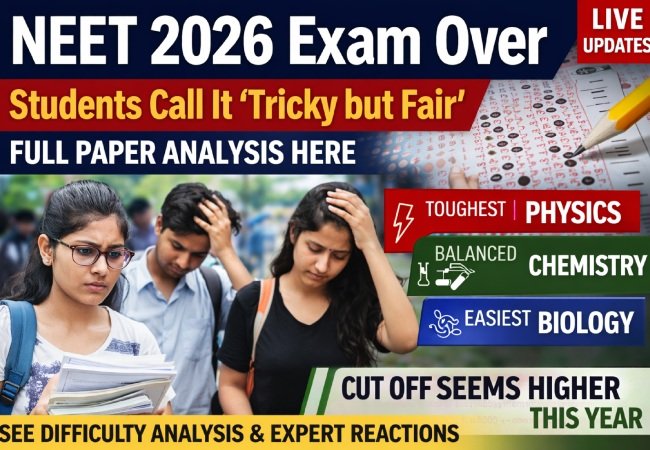
The long wait is finally over. The NEET 2026 concluded at 5 PM today, bringing a mix of relief and anxiety for millions of students across India. After months—and for many, years—of hard work, candidates walked out of exam centres with different emotions. Some looked confident, while others were unsure. Now, all eyes are on the NEET 2026 paper analysis to understand how the exam actually went.
Before the Exam: Nerves, Hope and Big Dreams
For most students, NEET is not just another test. It’s the gateway to becoming a doctor. From last-minute revisions to sleepless nights, the pressure was real. As the exam began at 2 PM, lakhs of aspirants entered their centres with one goal in mind—cracking NEET 2026. Now that it’s over, students are comparing answers and sharing their first reactions.
Overall Difficulty: Moderate but Challenging
According to early feedback, the paper was moderate to tough overall. It was not extremely difficult, but it was far from easy. Many students said the paper focused more on understanding concepts rather than memorising facts.
Physics turned out to be the toughest section, while Biology gave students some relief. This balance could mean that the cutoff remains competitive this year.
Physics: Toughest Section Again
Physics lived up to its reputation. Questions were mostly concept-based and calculation-heavy, especially from topics like Mechanics, Electrostatics, and Optics. Many students found the section lengthy and tricky.
Some easier questions came from Modern Physics and Semiconductors, but overall, Physics demanded strong preparation. Many aspirants felt it was slightly tougher than last year.
Chemistry: Balanced and Scoring
Chemistry was relatively easier compared to Physics. It was a well-balanced section covering Organic, Physical, and Inorganic topics.
- Organic Chemistry had direct reaction-based questions
- Physical Chemistry involved calculations but was manageable
- Inorganic focused on NCERT concepts
Students who studied NCERT properly found this section scoring.
Biology: The Most Student-Friendly Section
Biology was the easiest and most scoring section in NEET 2026. Most questions were directly from NCERT, especially from topics like Human Physiology, Genetics, and Ecology.
There were a few assertion-reason questions, but overall, students found Biology straightforward. Many candidates felt this section helped boost their confidence.
Key Highlights from NEET 2026 Paper
- Total Questions: 180
- Paper Type: Concept-based and application-focused
- Physics: Lengthy and difficult
- Chemistry: Balanced
- Biology: Easy and scoring
- Time Management: A major challenge, especially in Physics
The exam clearly rewarded students who focused on concepts rather than last-minute cramming.
Expected Cutoff and What Comes Next
Experts believe the cutoff may be similar to or slightly higher than last year, considering the overall difficulty level. However, official answer keys and results will take some time.
Students are advised to stay calm and wait for updates. Counselling and further steps will follow soon after results are declared.
Difficulty Level Summary
| Subject | Difficulty Level | Key Observations | Good Attempts |
|---|---|---|---|
| Physics | Moderate to Tough | Calculation-heavy, tricky | 35–40 |
| Chemistry | Easy to Moderate | NCERT-based, balanced | 40–45 |
| Biology | Easy to Moderate | Direct questions, scoring | 50+ |
| Overall | Moderate | Concept-focused | 130–150 |
Final Words
Whether you feel confident or unsure after the exam, completing NEET itself is a big achievement. This paper tested clarity, patience, and preparation. Remember, one exam does not define your future. Stay positive and wait for the official results.
FAQs
Q1. What was the difficulty level of NEET 2026?
Moderate to tough, with Physics being the hardest section.
Q2. Which subject was easiest?
Biology was the most scoring and student-friendly.
Q3. When will answer keys be released?
Official keys are expected within a few weeks.
Q4. Was NEET 2026 tougher than last year?
Physics was slightly tougher, but overall level remained similar.
Q5. What should students do now?
Relax, review your performance, and prepare for counselling.
Disclaimer
This analysis is based on initial student reactions and expert opinions. The final answer key and results released by authorities may differ.
