Picture this: you launch your favorite open-world game with everything maxed out—high-resolution textures, ray tracing on—and your GPU still runs smoothly. No lag, no “VRAM full” errors, just clean and stunning visuals. This isn’t some distant dream. It’s already becoming real with NVIDIA Neural Texture Compression.
Reports claim this AI-powered tech can cut GPU memory usage by up to 85% without any loss in quality. For gamers who’ve struggled with hardware limits, this feels like a big relief.
In this guide, we’ll break down NVIDIA Neural Texture Compression in simple terms, with real examples and clear explanations. Let’s get started.
Table of Contents
ToggleWhat Is NVIDIA Neural Texture Compression?
NVIDIA Neural Texture Compression is an AI-based technology that reduces the size of game textures without reducing visual quality.
Older methods like BC7 compression have worked well for years. But this new approach goes further by using neural networks trained specifically for textures used in games.
Instead of storing every single pixel, this system learns how a texture looks—its color, lighting, and surface details—and saves a compact version. When the game runs, a small AI model inside the GPU rebuilds the texture instantly.
The result? Smaller files, same (or even better) visuals.
How Does It Work?
This technology compresses all texture data of a material—like color, lighting, and surface roughness—into one compact format.
Then, a small neural network (called an MLP decoder) restores the texture in real time while the game is running.
Thanks to features like DirectX Cooperative Vectors and tensor cores in RTX GPUs, this process is extremely fast and has almost no impact on performance.
Recent updates have made the system even better, with encoding speeds up to 6 times faster and further memory savings. It also delivers consistent, accurate results without visual glitches.
Why Gamers Are Excited
The biggest benefit is massive memory savings.
In one demo:
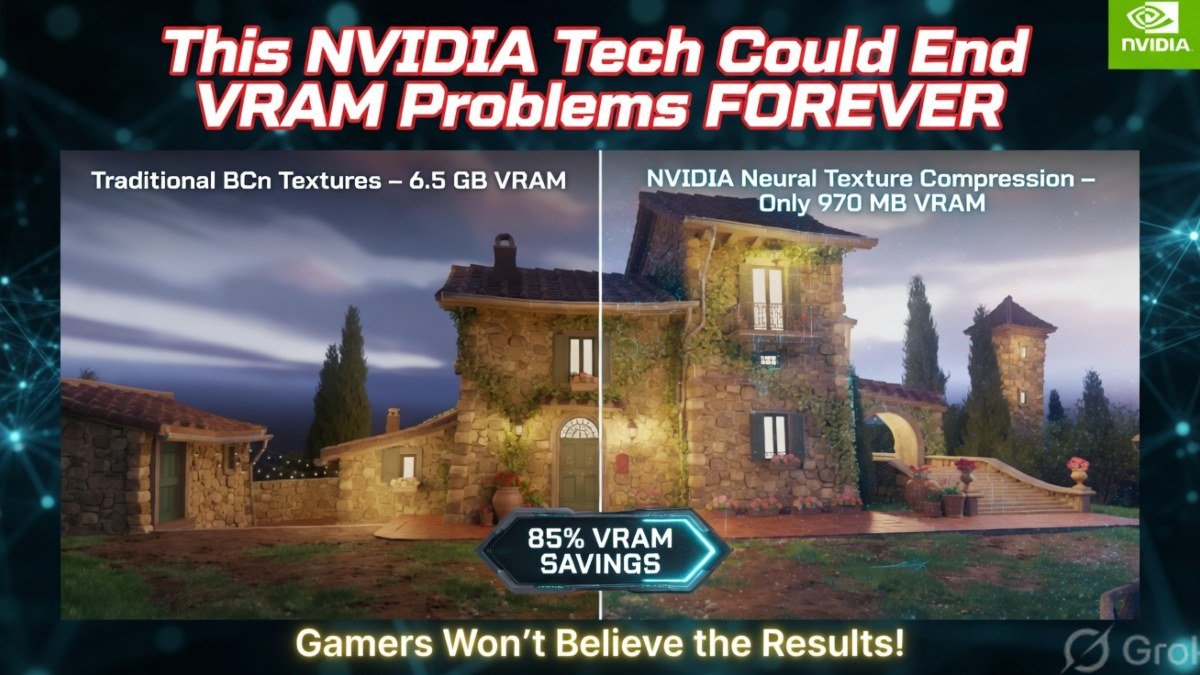
- A scene that used 6.5 GB of VRAM dropped to just 970 MB
- That’s around 85% less memory usage, with no visible quality loss
In another case:
- A texture went from 272 MB to just 11.37 MB
This is especially useful for gamers using 8 GB GPUs.
Other benefits include:
- Faster loading times
- Smaller game sizes
- Ability to use higher-resolution textures without performance issues
In short, better graphics without needing expensive hardware.
Real-World Demos
NVIDIA showed this technology live during GTC, with side-by-side comparisons.
One example, the Tuscan Villa scene, looked almost identical to the original but used much less memory.
Developers and testers using the public SDK have reported up to 90% VRAM reduction in real-world scenarios.
This isn’t just a lab experiment. The technology is already available in the RTX Neural Shaders SDK (v0.9.2 beta) and works with game engines like Unreal Engine and Unity.
Compared to Traditional Compression
Older compression methods often struggle with detailed textures and can create visible artifacts.
NVIDIA Neural Texture Compression:
- Delivers better image quality
- Uses much less memory
- Works well with complex textures
It doesn’t just improve existing methods—it makes them outdated.
Why It Matters to Gamers
Many gamers upgrade their GPUs only to hit memory limits again in newer games.
This technology helps solve that problem.
It allows even mid-range GPUs to handle high-quality graphics more easily. Whether you’re using an RTX 4060 or planning future upgrades, this means fewer compromises and better performance.
What’s Next?
When combined with technologies like DLSS and ray tracing, Neural Texture Compression could shape the future of gaming.
It may power:
- More realistic game worlds
- Advanced simulations
- Next-generation AAA titles
As more developers adopt this technology, we can expect to see it in upcoming games within the next 12–18 months.
Comparison Table: At a Glance
| Feature | Traditional Compression | Neural Texture Compression |
|---|---|---|
| VRAM Usage | 6.5 GB | 970 MB (85% less) |
| Compression Ratio | ~8x | Up to 24x+ |
| Visual Quality | Good, may show artifacts | Higher quality, fewer errors |
| Decompression | Hardware-based | AI-based, real-time |
| Texture Detail | Limited | Much higher possible |
| Developer Support | Mature | New but growing fast |
Conclusion
NVIDIA Neural Texture Compression is more than just another upgrade. It solves one of the biggest problems in gaming—limited VRAM.
It means better visuals, smoother performance, and less need for constant hardware upgrades.
For gamers, this could be a major turning point. The next generation of gaming might not just look better—it might finally run better too.
FAQs
Q1: When will games start using this?
Developers are already testing it. Major games may support it within 12–18 months.
Q2: Do I need a special GPU?
It works best on RTX 40/50 series GPUs, but can run on other modern hardware with proper support.
Q3: Will it reduce performance?
No. The impact is very small—often less than 0.5 ms per frame.
Q4: Is it available to developers?
Yes, it’s part of NVIDIA’s free RTX SDK and available on GitHub.
Q5: How does it compare to Intel’s version?
Both are strong, but NVIDIA’s version is more integrated with RTX features.
Disclaimer
This article is for informational purposes only. All details are based on publicly available demos, research, and SDK information as of April 2026. Actual performance may vary depending on hardware, drivers, and game implementation. This content is not affiliated with NVIDIA.
Author

मैं विकास शुक्ला, एक पैशनेट कंटेंट क्रिएटर और लेखक हूँ, जो राजनीति, अर्थव्यवस्था, स्टॉक मार्केट और ताज़ा खबरों पर गहराई से लिखता हूँ। मुझे जटिल मुद्दों को आसान और समझने योग्य भाषा में पाठकों तक पहुँचाना पसंद है।
मेरे लेख राजनीति की नीतियों से लेकर स्टॉक मार्केट की हलचल और आम लोगों को प्रभावित करने वाले आर्थिक मुद्दों तक सबकुछ कवर करते हैं। मेरा उद्देश्य है कि पाठकों को न सिर्फ जानकारी मिले, बल्कि उन्हें सही दिशा में सोचने और निर्णय लेने की प्रेरणा भी मिले।
👉 मैं ब्लॉग आर्टिकल्स, न्यूज़ एनालिसिस और ट्रेंडिंग टॉपिक्स पर लगातार लिखता हूँ ताकि हर पाठक को भरोसेमंद और निष्पक्ष जानकारी मिल सके।
