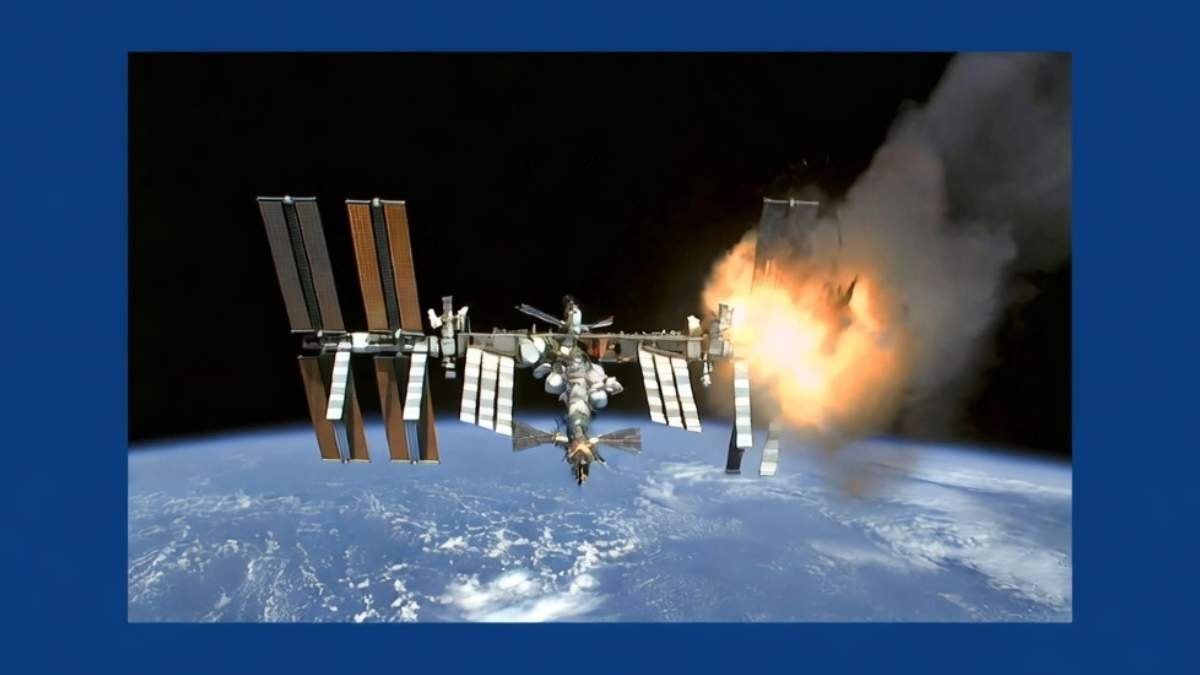
Imagine launching something into the cosmos, watching it orbit our beautiful blue planet for 14 long years — and then watching it come home. Not in a blaze of glory, but in a fiery descent through Earth’s atmosphere that most of us will never see.
That’s exactly what is happening today, March 10, 2026. NASA’s Van Allen Probe A — a 600-kilogram (1,323-pound) scientific satellite — is crashing back to Earth. And while that might sound terrifying, this NASA satellite crash is actually one of the most fascinating scientific events of the year.
So what is the Van Allen Probe A? Why is the NASA satellite crash happening today? Should you be worried? And what does it mean for science and space exploration? Let’s explore everything — with the wonder, emotion, and detail this extraordinary moment deserves.
What Is the Van Allen Probe A? A Brief Story
Back in August 2012, NASA launched twin spacecraft into the heavens with a clear mission: to study Earth’s Van Allen radiation belts — invisible, donut-shaped zones of charged particles trapped by Earth’s magnetic field, stretching thousands of miles above our planet.
These belts, named after physicist James Van Allen who discovered them in 1958, are dynamic and dangerous. They bombard satellites with high-energy particles and can even affect power grids on Earth during intense solar storms. Understanding them was — and still is — critically important.
Van Allen Probe A and its twin, Probe B, were designed to last just 2 years. They kept operating until 2019 — nearly triple their planned lifespan — collecting invaluable data about radiation, solar activity, and Earth’s magnetic shield. Then they were deactivated, left to drift silently in orbit, their work complete.
But space doesn’t let things rest forever. And today, gravity wins. The NASA satellite crash is here.
Why Is the NASA Satellite Crash Happening NOW — Earlier Than Expected?
This is where the story gets really interesting — and a little humbling for all of us who think we can predict everything.
Van Allen Probe A was originally expected to stay in orbit until 2034. Eight more years of silent, harmless drifting. But something changed — and that something is our Sun.
The Sun is currently in a period of heightened solar activity known as Solar Maximum. During this phase, the Sun unleashes powerful flares and coronal mass ejections that dramatically increase the density of Earth’s upper atmosphere. More atmosphere means more drag on orbiting spacecraft. More drag means satellites lose altitude faster.
The result? Van Allen Probe A’s orbit decayed far more rapidly than NASA’s models predicted. Instead of gliding through space until 2034, it is now plummeting toward Earth on March 10, 2026 — nearly 8 years ahead of schedule.
This NASA satellite crash is, in a very real sense, caused by the same Sun that the probe once studied. There is a poetic — almost cinematic — quality to that irony.
“The same solar activity that the Van Allen Probes studied is now pulling one of them back home.” — The Story of Probe A
What Happens During the NASA Satellite Crash Re-Entry?
When a satellite re-enters Earth’s atmosphere, it doesn’t just silently fall. It battles. The spacecraft hits molecules of air at speeds of thousands of miles per hour, and the friction generates temperatures so extreme that most of the metal, wiring, and components simply disintegrate into dust and gas.
For the Van Allen Probe A NASA satellite crash, here is what scientists expect:
Most of it burns up: NASA and the US Space Force confirm the vast majority of the 600 kg spacecraft will be incinerated as it travels through the atmosphere. It will light up the sky in a streak of fire and light — invisible to most of us, but detectable by tracking stations.
Some pieces may survive: Certain components — particularly denser materials and hardware with high melting points — may survive re-entry and reach Earth’s surface. These are called ‘surviving fragments’ and can range from small, palm-sized pieces to larger chunks.
Re-entry time: The US Space Force predicted re-entry at approximately 7:45 PM EDT on March 10, 2026, with an uncertainty window of plus or minus 24 hours. Tracking continues until the final moment.
The exact location of where surviving debris will land is extremely difficult to predict until just hours before the event — another reminder that the NASA satellite crash is nature, math, and physics combining in real time.
Should You Be Worried? The Real Risk of the NASA Satellite Crash
Let’s address the elephant in the room: is anyone going to get hit by falling space debris from this NASA satellite crash?
The short answer is: almost certainly not. But let’s look at the actual numbers.
NASA’s official risk assessment: The probability of the NASA satellite crash debris harming any individual human being is approximately 1 in 4,200. To put that in perspective, you have a higher chance of being struck by lightning in your lifetime.
Why is the risk so low? Earth is enormous — and mostly ocean. Over 70% of the planet’s surface is water. Even if debris survives re-entry, the statistical probability of it landing on a populated area is vanishingly small.
Historical precedent: In the entire history of the space age, no human being has ever been confirmed killed by falling satellite debris. While pieces of old rockets and satellites do occasionally land on Earth, they typically splash into oceans or land in remote, uninhabited regions.
So — breathe easy. The NASA satellite crash is a spectacle of science, not a cause for alarm.
What Did Van Allen Probe A Discover? A Legacy Worth Remembering
Before we watch Van Allen Probe A burn up, let’s honour its incredible scientific legacy. This spacecraft — now crashing back to Earth — fundamentally changed our understanding of the space environment surrounding our planet.
Radiation Belt Dynamics: The probe revealed that the Van Allen belts are far more complex and variable than scientists previously understood. They can swell, shrink, and even temporarily create a third belt — something no one predicted before this mission.
Space Weather Forecasting: By studying how solar activity affects the radiation belts, the mission dramatically improved our ability to forecast dangerous space weather events — protecting satellites, power grids, and astronauts on the ISS.
Particle Acceleration Mysteries: The probe helped scientists understand how electrons in the Van Allen belts are accelerated to nearly the speed of light — a fundamental physics question that had puzzled researchers for decades.
Even today, years after the satellite was deactivated, scientists continue mining its archived data for new discoveries. The Van Allen Probe A NASA satellite crash ends its physical journey — but its scientific journey continues.
The Bigger Picture: Space Junk and Our Cluttered Skies
The NASA satellite crash is just one small part of a much larger — and growing — challenge facing humanity in the 21st century: space debris.
As of early 2026, there are roughly 15,000 active satellites orbiting Earth, with thousands more pieces of dead satellites, spent rocket stages, and fragments of past collisions drifting in orbit. Scientists have coined a term for the worst-case scenario: Kessler Syndrome.
Kessler Syndrome: First described by NASA researcher Donald Kessler in 1978, this theory predicts that if enough debris accumulates in low Earth orbit, collisions between objects would generate even more debris, triggering a catastrophic chain reaction that could make Earth’s orbit unusable for generations.
Researchers have recently developed a ‘CRASH Clock’ — measuring how quickly a catastrophic chain reaction of satellite collisions would begin if orbital control was lost. The current estimate is alarmingly short: under 3 days. That’s how crowded our skies have become.
The NASA satellite crash of Van Allen Probe A is a controlled, predicted event. But it is also a reminder that every satellite we put up must eventually come down — and we need better plans for managing that.
What Happens to Van Allen Probe B?
Van Allen Probe A may be making headlines today, but its twin — Van Allen Probe B — is still out there, circling Earth in silence.
Unlike its partner, Probe B’s orbit is decaying more slowly. Scientists currently predict it will not re-enter Earth’s atmosphere until at least 2030. When it does, another NASA satellite crash event will be carefully monitored by space agencies around the world.
The fate of both probes is a beautiful metaphor: even the most advanced human creations are temporary visitors in the cosmos. They serve their purpose, they illuminate our understanding, and then they return to where they came from.
NASA Van Allen Probe A — Key Facts at a Glance
| 📌 Parameter | 📋 Details |
| Satellite Name | Van Allen Probe A (RBSP-A) |
| Launch Date | August 30, 2012 |
| Launch Vehicle | Atlas V 401 |
| Weight | 600 kg (1,323 lbs) |
| Original Mission Duration | 2 years |
| Actual Active Period | 2012–2019 (7 years) |
| Original Re-entry Estimate | 2034 |
| Actual Re-entry Date | March 10, 2026 |
| Re-entry Time (Est.) | 7:45 PM EDT ± 24 hrs |
| Reason for Early Re-entry | Increased solar activity / Solar Maximum |
| Risk to Humans | Approx. 1 in 4,200 |
| Twin Spacecraft | Van Allen Probe B (re-entry ~2030) |
| Key Discovery | Third Van Allen Belt, radiation dynamics |
| Monitoring Agency | NASA + US Space Force |
Conclusion:
There is something profoundly moving about watching a spacecraft come home. The NASA satellite crash of Van Allen Probe A is not a disaster. It is a farewell — a fiery, glorious farewell to a machine that spent 14 years in the cold darkness of space, doing science that matters.
Because of Van Allen Probe A, we understand Earth’s magnetic environment better. We can forecast space weather more accurately. We have protected satellites, power grids, and human lives. All of that — from a 600-kilogram box of electronics launched into the void back in 2012.
As you go about your day today, take a moment to look up at the sky. Somewhere out there, a piece of human ingenuity is making its final journey home. And while most of it will burn up in the atmosphere — unseen and unheralded — it will leave behind something that can never burn: knowledge.
The NASA satellite crash ends a mission. But science never ends. And in that truth, there is every reason for hope.
Frequently Asked Questions (FAQs)
Q1. What is the NASA satellite crash happening today?
The NASA satellite crash refers to the uncontrolled re-entry of Van Allen Probe A into Earth’s atmosphere on March 10, 2026. The 600 kg spacecraft is expected to mostly burn up, with some fragments potentially reaching the surface.
Q2. Is the NASA satellite crash dangerous?
No. NASA puts the risk to any individual human at approximately 1 in 4,200. Most of the debris will burn up, and any surviving pieces are overwhelmingly likely to land in an ocean or uninhabited area.
Q3. Why is the NASA satellite crash happening 8 years early?
The Sun is currently at Solar Maximum, producing intense activity that expanded Earth’s upper atmosphere. This increased atmospheric drag on the satellite, accelerating the decay of its orbit far beyond original predictions.
Q4. Can I see the NASA satellite crash?
Possibly, if you are in the right location at the right time. Re-entry events can appear as a bright streak or fireball in the sky. Tracking websites like Heavens-Above and Space-Track provide real-time orbital data.
Q5. What happens to Van Allen Probe B after Probe A’s NASA satellite crash?
Probe B remains in orbit and is not expected to re-enter Earth’s atmosphere until at least 2030. It will undergo a similar monitored re-entry process when its time comes.
Q6. What did the Van Allen probes discover?
The probes discovered the existence of a temporary third Van Allen radiation belt, revealed how particles are accelerated to near-light speeds, and dramatically improved global space weather forecasting capabilities.
DISCLAIMER
This blog is for informational and educational purposes only. All data, re-entry timings, risk assessments, and scientific details are sourced from NASA, the US Space Force, and reputable science publications as of March 10, 2026. Re-entry predictions are subject to change. Readers should consult official NASA and US Space Force channels for the most current updates. The author is not responsible for any decisions made based on this content.